Matter Makes Not Mind
A second part in a series considering the nature of consciousness.
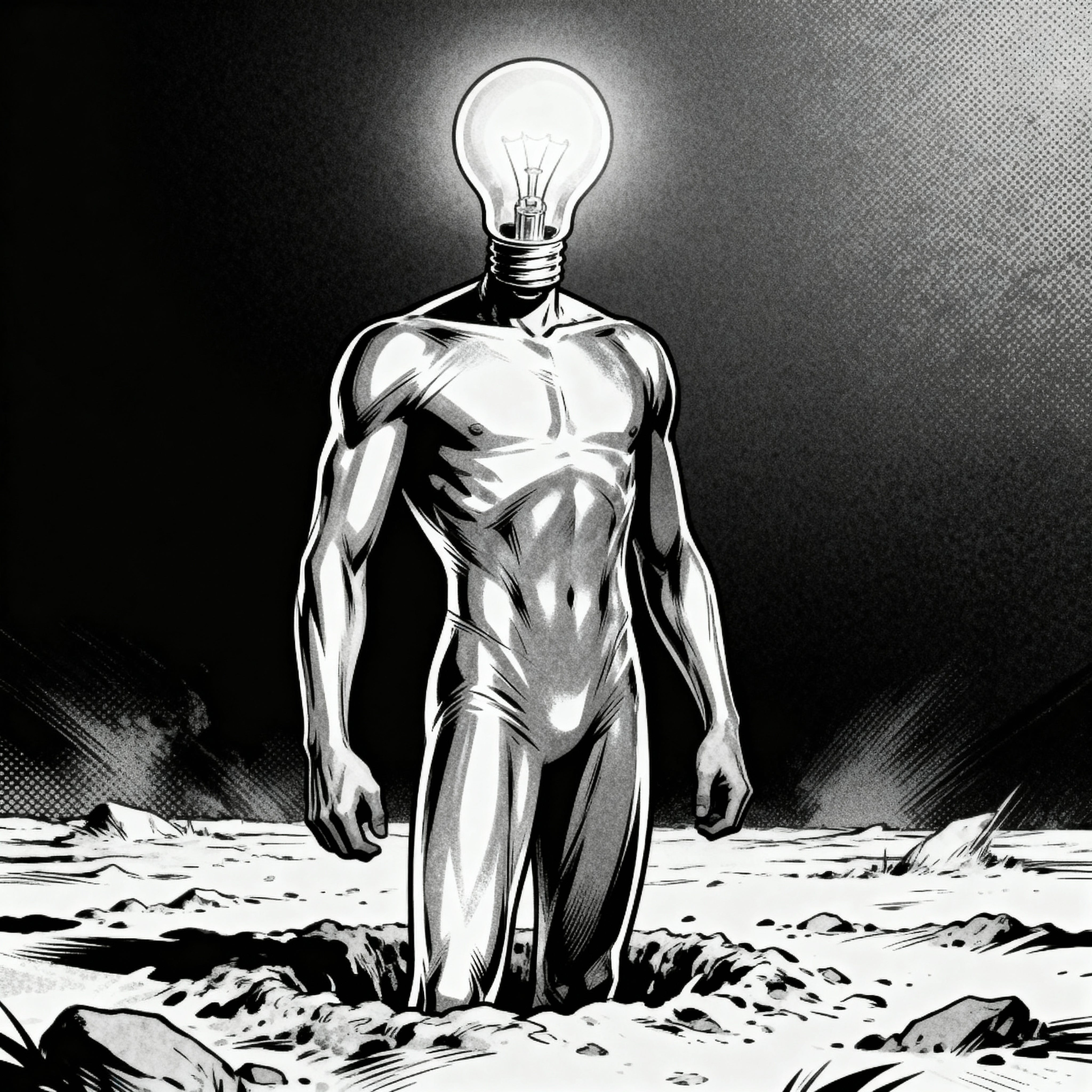
Last week, I wrote about the idea that there’s no “I” in AI — in other words that there’s no reason to suppose that artificial intelligence algorithms have yet, nor ever will generate, as an emergent property, an actual perceiver — an “I” like you or me. While AI mechanisms can account for the coherent processing of information that is consistent with this kind of “I,” (what David Chalmers calls the Easy Problems of consciousness), it was argued that they in no way account for the qualities of an actual perceiver (what Chalmers calls the Hard Problems of consciousness).
This week, that argument is taken one simple step further. If AIs can never be expected to produce a perceiver as an emergent property, then the reasoning can be interpreted broadly: It’s not just because the switches on which computers are based give no indication of being able to produce a perceiver; it’s because because no configuration of mere matter and energy gives an indication of being able to produce a perceiver.
As far as I can see, the only real evidence that suggests that the so-called natural universe — i.e., a universe foundationally composed of matter and energy — produces consciousness is the fact that consciousness obviously does animate certain configurations of matter. Or, for instance, that neural activity closely correlates with various forms of conscious experience. The crux of the argument that consciousness is an emergent property of matter and energy, or what in our modernist-formed world we call “nature,” is simply the force of the conviction that it has to be this way, because consciousness self-evidently exists, and because the existence of an all-encompassing ground of consciousness is resisted.
Except, clearly, this doesn’t have to be the only way of looking at it. Consciousness doesn’t have to be emergent from non-conscious phenomena. It could be, instead, that consciousness is the ground of reality, and that matter is a coalescent property of consciousness instead. For many reasons, I am convinced this is the way things actually are, but to me it even bears out as the superior explanation from a logical perspective. To me, the idea that matter coalesces from consciousness is ultimately the simpler, more elegant, and more coherent one.
Roughly, this is how one might suppose it works: The ground of being — the foundational consciousness — particularizes itself into subsidiary, individual consciousnesses, and each of these subsidiary, individual consciousnesses is distinguished by an inside and an outside. Inside, there is awareness — the subjective experience you and I have. Outside, there is some amount of opacity. For instance, though we can and, for the sake of relatedness, must attempt to understand and model the interiority of others, the true subjective interior experience of another being is not accessible to us the way our own interiority is, and our own interiority cannot be shared with another as a direct experience.
Matter could be a particularization of consciousness such that this opacity is not only an opacity of subjective experience; it’s also opacity in terms of resistance to force, opacity to light, etc. In other words, what we perceive as matter is just the “outside” part of granules of particularized consciousness.
Interestingly, then, matter is formed into bodies, and the consciousness that any of us would experience as ourselves works cooperatively with these particularlizations, having the experience that’s somewhat loosely called mind-in-body. This seems to me to be a pretty straightforward explanation, and to me it efficiently accounts for the fundamental differences between matter and consciousness.
To me, it’s easier to explain the apparently inert qualities of matter in terms of consciousness taking on some kind of restful state, for instance, than it is to explain the dynamism of consciousness as the result of some necessarily animate tendency of matter. And it’s way easier to explain subjective experience itself as something that pre-exists rather than to try to explain how matter and energy — which are just nothing like subjective experience, end up generating it.
As I said last week, I think the plausibility of the idea that consciousness arises from matter and energy is partly a trick of the imagination; which is to say I think it’s largely the human capacity for abstraction that gives the physicalist argument any traction at all. It’s possible to think in an imaginative, abstract way about matter — apart from direct observation or experience — and to think in an imaginative and abstract way about consciousness — apart from direct observation or experience — and to suppose that matter complexifies itself, first into particles, then into atoms, then into chemistry, then into the chemistry of life, then into neurons and eventually into consciousness.
But to me, this reasoning, while apparently rational, is also fairly illusionary. And among other things, I think it’s pretty solidly refuted by the process of vipassana, or the contemplative study of awareness itself. For centuries, since long before the sacking of Jerusalem, the Vedic tradition has averred that the original principles of existence are Purusha and Prakriti: a receptive, perceptive aspect and an active, dynamic, willful aspect. These concepts were not derived rationally, as logical necessities; instead, they were discovered through a deep act interior contemplation.
If one takes even a few minutes to study one’s own consciousness — letting go of imaginative abstractions about matter and mind and just paying attention to one’s attention — I think it quickly becomes clear that awareness is a receptive aspect that it so entirely qualititatively unlike matter that it is not at all easy to explain its existence in terms of matter.
As David Bentley Hart eloquently puts it:
How could it be that, in this instance alone, the essential aimlessness of matter achieves so intense and intricate a concentration of its various random forces that, all at once, it is fantastically inverted into the virtual opposite of everything modern orthodoxy tells us matter is? In the end, there will always remain that essential part of the conscious self that seems simply to stand apart from the spectacle of material causality: pure perspective, a gaze in upon reality that is itself available to no gaze from beyond itself, known to itself only in its act of knowing what is other than itself. For a scientific culture that believes true knowledge of anything can be gained only by the systematic reduction of that thing to its simplest parts, undertaken from an entirely third person stance, this inaccessible first person subjectivity—this absolute interiority, full of numberless incommunicable qualitative sensations and velleities and intuitions that no inquisitive eye will ever glimpse, and that is impossible to disassemble, reconstruct, or model—is so radically elusive a phenomenon that there seems no hope of capturing it in any complete scientific account. Those who imagine otherwise simply have not understood the problem fully.1
To wit, it’s just very, very hard to explain consciousness in terms of matter, because there is just nothing objective about subjective awareness.
If you imagine matter in a certain way — as an idea, apart from observation — and you imagine consciousness a certain way — again, as an idea, apart from observation — it can start to seem plausible that consciousness can emerge from matter.
But instead, just take a few minutes to observe your attention, your consciousness — the “I” that you are. Don’t imagine objects, don’t imagine consciousness, just look at your awareness.
Upon full observation of your attention, is there anything about your awareness that is like the material part of the universe?
Do you result from matter? Can you?
There’s more that could be said about the materialist argument versus the consciousness-first argument. But the yogis are particularly explicit in telling us that as we, the particular, look within, the secret of the ground from which we emerge begins to divulge itself. This may sound like a superstitious form of magical thinking: that looking at the interior of your mind will result in a deep disclosure about the basis of reality.
But if the ground of reality is indeed conscious, why wouldn’t inner contemplation result in some kind of revelation? If the ground is conscious, the study of reality itself is inherently relational.
If an interior query produces an enlightening result, it could simply be because that foundational ground of consciousness, with which we are relating, is benevolent.
This series of essays continues here.
The Experience of God: Being, Consciousness, Bliss, pp. 157-8
Love this perspective! Something to chew on post-Pilates.