Deconstructing "Scientism"
Poking around with the epistemological escape room of our era.
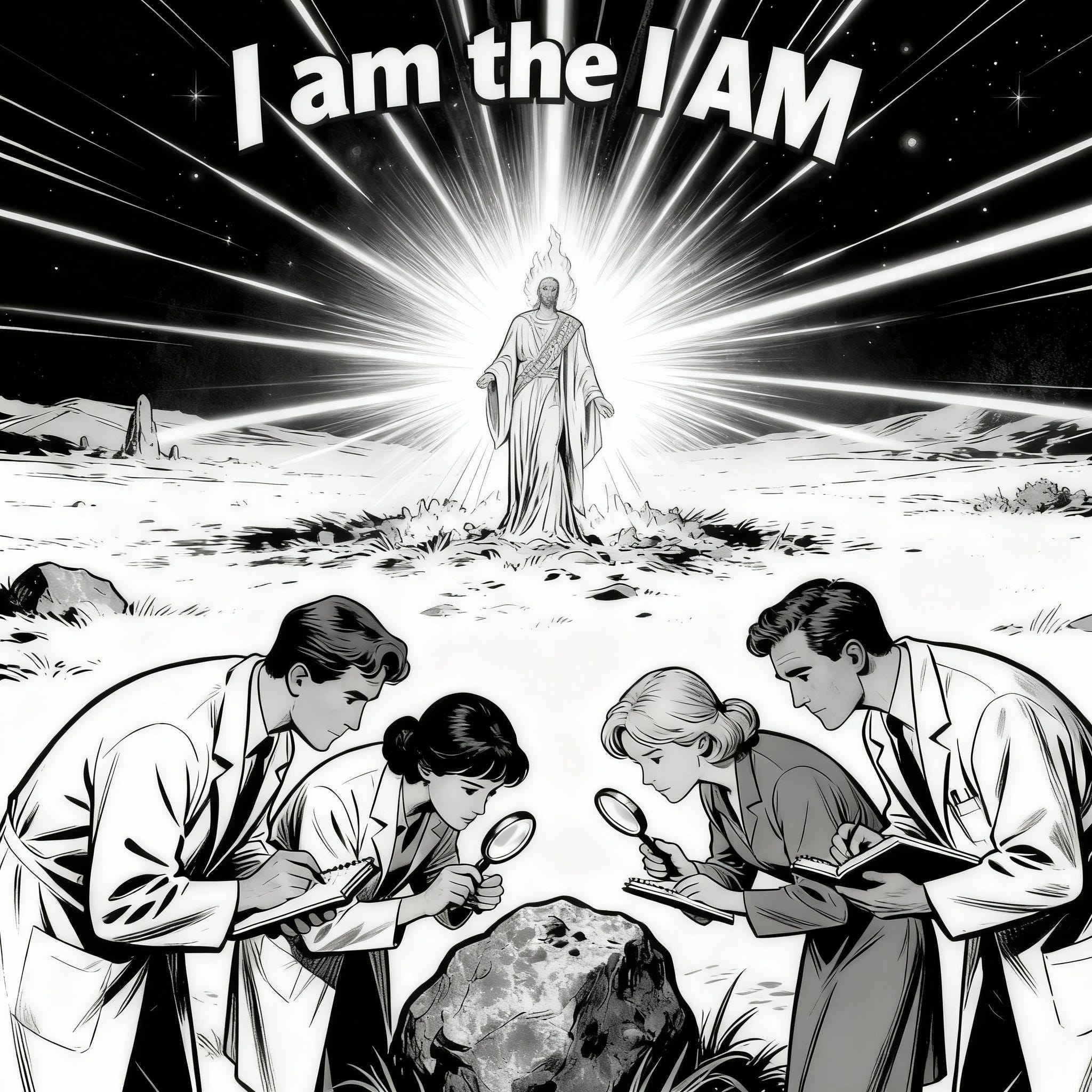
The past month or so, I’ve been thinking about the argument that consciousness arises from matter, versus the argument that matter arises as a precipitation of consciousness. A few weeks back, I explored that idea that AI won’t ever be conscious, and the following week I opined that matter doesn’t seem to be able to generate consciousness at all — because the qualities of matter are so unlike the qualities of consciousness. Then I argued, as best I could, that maybe there isn’t such a thing as emergence, in an absolute sense, but that the most reasonable hypothesis is that the ground of being contains all attributes, of being and consciousness, originally.
These arguments haven’t been utterly thorough. There are whole books written about what’s been sketched out in a relatively few paragraphs. The arguments are perhaps best said to be undertaken in the spirit of this Substack — which is the spirit of thinking aloud.
And they aren’t how I personally enter into the ontological conversation, either. I don’t know when my earliest thinking about God happened, but I am sure that I was never persuaded that consciousness precedes matter. For me, this understanding is just sort of hard-wired. I’m interested in the rational argument that consciousness comes first because it’s salient for many people. But personally I view it as a sort of game, like an intellectual escape room: Let’s accept a widely-held set of epistemological constraints, which privilege certain forms of observation, measurement, and logic, and see if it’s possible to work our way from physicalism to something more truly mystical.
One might suppose that big ontological questions are purely a matter of faith — essentially unprovable. But especially recently, philosophers like David Bentley Hart and Bernardo Kastrup have been making the case that some form of theism or, at the very least, some form of consciousness-first argument is more plausible even from a rational and scientific perspective — and that the rational case is actually rapidly becoming more and more robust.
I’ve been reading Bernardo Kastrup’s books in particular recently, including Analytic Idealism in a Nutshell, and Why Materialism is Baloney. Kastrup, a Ph.D.-level computer scientist whose first job was at the CERN (the European nuclear research facility), is adamantly consciousness-first. He proceeds from what I think is one of the pivotal observations of our moment: At the institutional level, the entire domain of metaphysics has become tied to a narrow set of assumptions that are presented as being the most reasonable, but are actually a form of dogma that is often more socially enforced than rationally argued. Meanwhile, there is an increasingly strong scientific case to be made, even, that consciousness is the the ground of reality, and the physicalist argument is actually demonstrably becoming the more absurd way to look at things.
Before getting into it, I feel like it’s worth parsing terms a little bit here. Kastrup has a tendency to lump together terms like “naturalism,” “materialism,” “physicalism,” and “scientism,” and there are folks who would chafe at the idea that they are all the same thing.
Naturalism, we could say, is the effort to build a model of the world through rational analysis of observable phenomena. Naturalism has become increasingly refined in the sciences. (And — right or wrong — it is the often viewed as the ultimate arbiter of reality in academic philosophy, as well.)
Physicalism, or materialism, on the other hand, could be defined as the presupposition that the ground of reality is best understood in terms of the “ontological primitives” of physics: matter, energy, and forces at work in spacetime (and then whatever ground from which spacetime and everything else emerges — which is also best understood in terms of physics). This is the essence of the argument that consciousness is an emergent property of matter, and not the other way around.
Meanwhile, what Bernardo Kastrup calls “scientism” is a dogmatic belief that empiricism is the only epistemological method that is worth any real regard. This is distinct from science; it’s a dogmatic tendency, not a truly rigorous approach to inquiry.
In the purest practice, there’s no reason for naturalism, or its even highest refinement in the sciences, to distort the ontological conversation one way or the other — provided that it stays in its lane. The rub, it seems to me, is that naturalism has become increasingly practiced with an unmistakable physicalist bias, which has become widely institutionalized — both academically and in the culture at large.
In theory, naturalistic inquiry holds all theories of being equally — that is (ideally) it holds them all loosely, agnostically, and at a distance, gradually working toward sturdier and sturdier conclusions, through assiduous rational study of observable phenomena. But in practice, I think naturalistic inquiry actually tends to hold that the consciousness-first argument has to prove itself, and the physicalist argument doesn’t. And this has become the pervasive worldview of academia in the industrialized world.
In its broad strokes, this tendency should be obvious to anyone. But in my experience, it’s also so deeply instilled that even intellectually rigorous people who feel they have stepped out of its box often haven’t stepped as far out of it as they think they have. And that feels worth some careful attention.
Consciously and unconsciously, the good idea of naturalism mostly does get turned into “scientism” — which, as Kastrup phrases it1, is ultimately the effort to derive a metaphysics of quality from the study of quantity. I think that’s an interesting way to put it.
So if I say, for instance, “I observe that I have no doubt that God is real,” the scientistic inclination — really, the naturalistic inclination, too — is to reply, not unreasonably, “Is that the only way to look at it? How can you be sure that you’re not imagining it?”
It’s a fair question, on its face. But also, actually, I think there’s a pretty good answer. You could start with the idea that intuition about existence of God feels qualitatively different from the experience of things that I imagine, and the effort to connect with God appears to result in dynamism outside of conscious agency that is unlike anything that occurs when I imagine things.
From there, you could note that this type of observation harkens to a kind of interior discipline that is fundamental to mysticism — which Buddhist and Vedic sages, for instance, have been systematizing for millennia. It’s borne out by consensus of devoted practitioners. It has its masters, and own its peer review process. It’s replicable.
But this is not easily folded into the scientistic worldview — because from the scientistic perspective authority of interior experience can’t be rigorously proven, except in the limited ways it can be measured through instrumentation. Where the phenomenology of “consciousness practice” is not rejected it is, at the very least, rounded down — both in the sciences and in the metaphysics that is wholly grounded in them. Here, a physicalist bias takes hold.
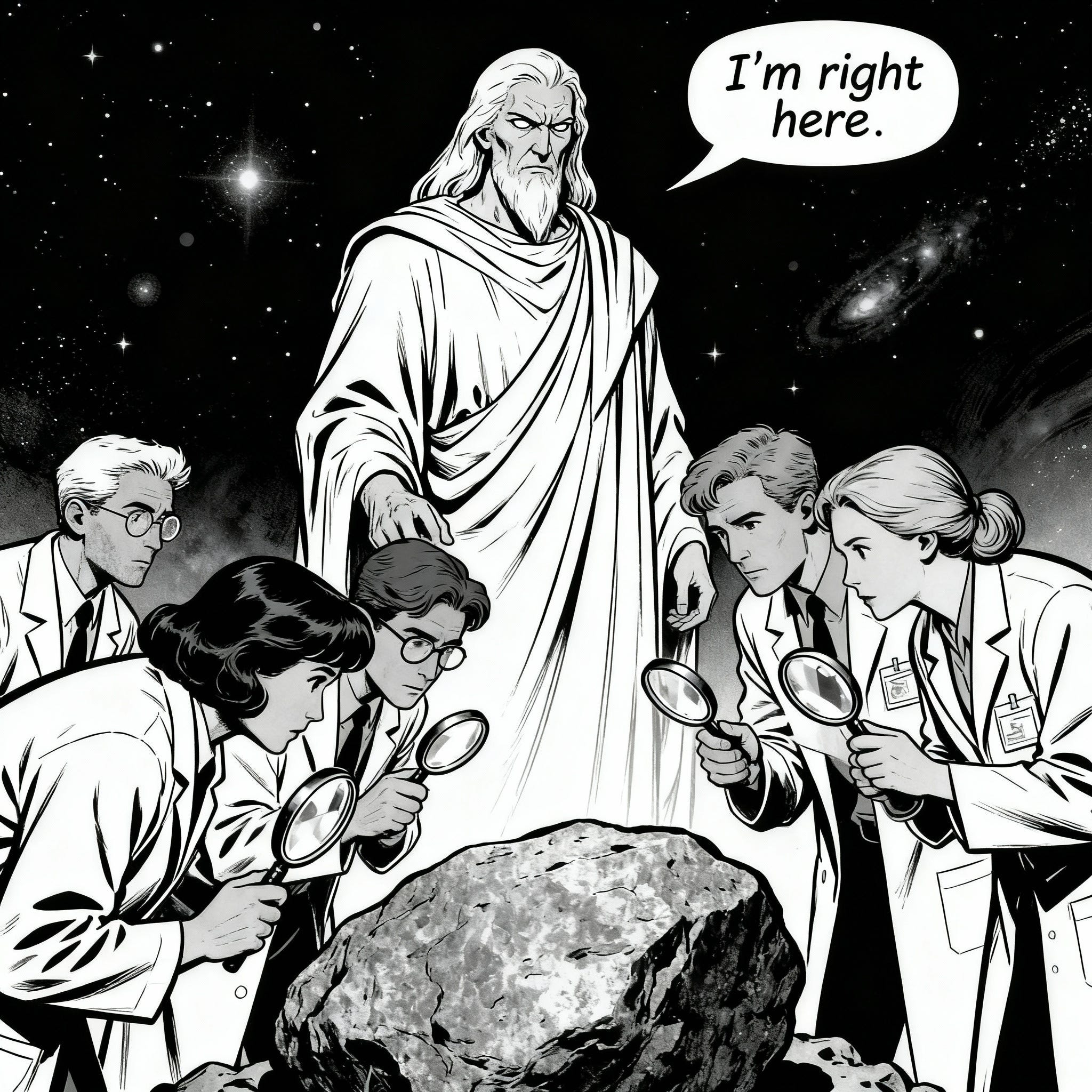
As it happens, though, even on its own terms, science is having more and more trouble supporting the physicalist worldview. Early in Analytical Idealism in a Nutshell, Kastrup mentions a few interesting recent pieces of evidence.
One, for instance, is a sequel to the famous double-slit experiments. Over time these studies have been building the case that the nature of instrumental observation determines whether tiny physical phenomena like electrons and photons, exhibit the qualities of particles or waves. In the more recent study, researchers found the phenomenon at work in quantum-entangled particles, with scientific observation of one particle affecting qualities of the other particle across a substantial distance, in a way that appeared to be instantaneous, and in a way that apparently ruled out many questions about hidden variables having a determinative effect — thereby greatly substantiating the idea that conscious really does seem to exhibit some form of preeminence over matter in these cases. (They were awarded the 2022 Nobel Prize in Physics for the work.)
Another line of evidence is one that I’d not heard before, which is that recent research consistently finds that psychedelics significantly decrease brain activity in many areas while showing no statistically significant evidence of stimulating brain activity anywhere. In other words, the expanded consciousness that is widely reported during psychedelic experiences appears to be the result of subduing the brain, not increasing its function — almost as though the psychedelic experience is the result of consciousness becoming unfettered by the brain, or from the brain being rendered in a more latent, and primordially ordered state, not from the brain being kicked into hyperdrive.
This latter research, as Kastrup notes, tracks with the admittedly anecdotal but also pretty numerous near-death experiences in which people report various forms of expanded consciousness once they leave the body — including the reported ability to see through solid matter; to see omni-directionally, both from the locus of consciousness, and all the way around an object being observed; and other experiences of transcending time, space, etc. If incarnate life occurs behind a “veil,” as esotericists often put it, there’s reason to suppose that this veil is closely related to the brain.
But again, the pervasive cultural bias kicks in. Kastrup points out that the media tended to interpret these latter findings superficially and in terms of conventional prejudices. Both an article in The Guardian and an article on CNN’s website published brain imagery from the study that showed increases in the latency of brain activity, but interpreted the images as instances of increases of brain activity. The CNN article explicitly said that the brain to “lit up” with activity, and Kastrup notes that these assertions have persisted even after he personally tried to talk CNN out of them.
Meanwhile, the anecdotal nature of NDEs has kept them at the fringes of consciousness studies altogether (and, bewilderingly, also academic theology). And the implications of the double-slit experiments have tended to remain corralled within a physicalist worldview — giving rise to theories that are increasingly alien and bizarre.
The dynamics that underlie these sorts of ideological prejudices can get a little complex. Kastrup points out that the physicalist bias that emerged during the Enlightenment was motivated partly by a desire to free the mantle of ontological authority from the inarguably powerful and inarguably dogmatic Church. And I find it interesting to note that in the early twentieth century even the emerging theory of the Big Bang was strenuously resisted by some leading cosmologists simply on the basis that it strongly suggested the existence of a moment of inception, or creation — and, therefore, a Creator.2
Interestingly, too, it seems to me that most of us tend to treat matters of the deepest contemplation — the nature of being, ethics, etc. — not only as domains of contemplation in themselves, but as social mediators, perhaps particularly these days. Consciously or not, I think many of us use social belonging as one of our main arbiters of truth: Conclusions that jeopardize our social status can be rounded down, even if this means that consensus reality drifts from what could be said to be actual reality — and even if consensus reality drifts from our own deeper intuitive sense of what’s real.
I’m left with the impression that, sadly, these kinds of social pressures are more salient than perhaps anything else today — at least sometimes and including at the institutional level. If so, I think that’s really worth some thought.3
It’s clear to me that naturalism has its place in philosophy, and it would be a big mistake to foment a social reflex in the other direction, making naturalism and/or science into a taboo. That’s silly.
But I do think it’s important that the biases be outed and scrutinized. Because they’re pervasive, and I think there have been significant consequences.
There’s no reason to stoke a fundamental antagonism between science and faith. But I think we should very least lay to rest the idea that physicalism is what grown-ups do and theism isn’t. Or even that agnosticism is what grown-ups do and theism isn’t.
Ultimately, I think, nothing could be further from the truth.
This series of essays continues here.
. . . in Analytical Idealism in a Nutshell
Michel-Yves Bollore and Olivier Bonnassies get into this in their book, God: The Science, the Evidence, which I’m just starting to read and which I’ll likely talk about in greater detail in another post.
This is part of the reason why I think all development, of any sort, ought to proceed at four levels at once.
You've given this a lot of thought. I believe completely that I came to know "god", undeniably, for me anyway, through empirical evidence. I believe that consciousness is primary, but that's because I believe the material world is conscious. Everything is in some way (I think). But the thing is, the material world is what matters, at least to people who care about their children and grandchildren. I don't believe that you live in a different material world than I do. Emergence is something that I think comes with action, from a human to a clock, emergent properties are present.