Does Emergence Exist?
A third part of a series of essays about consciousness.
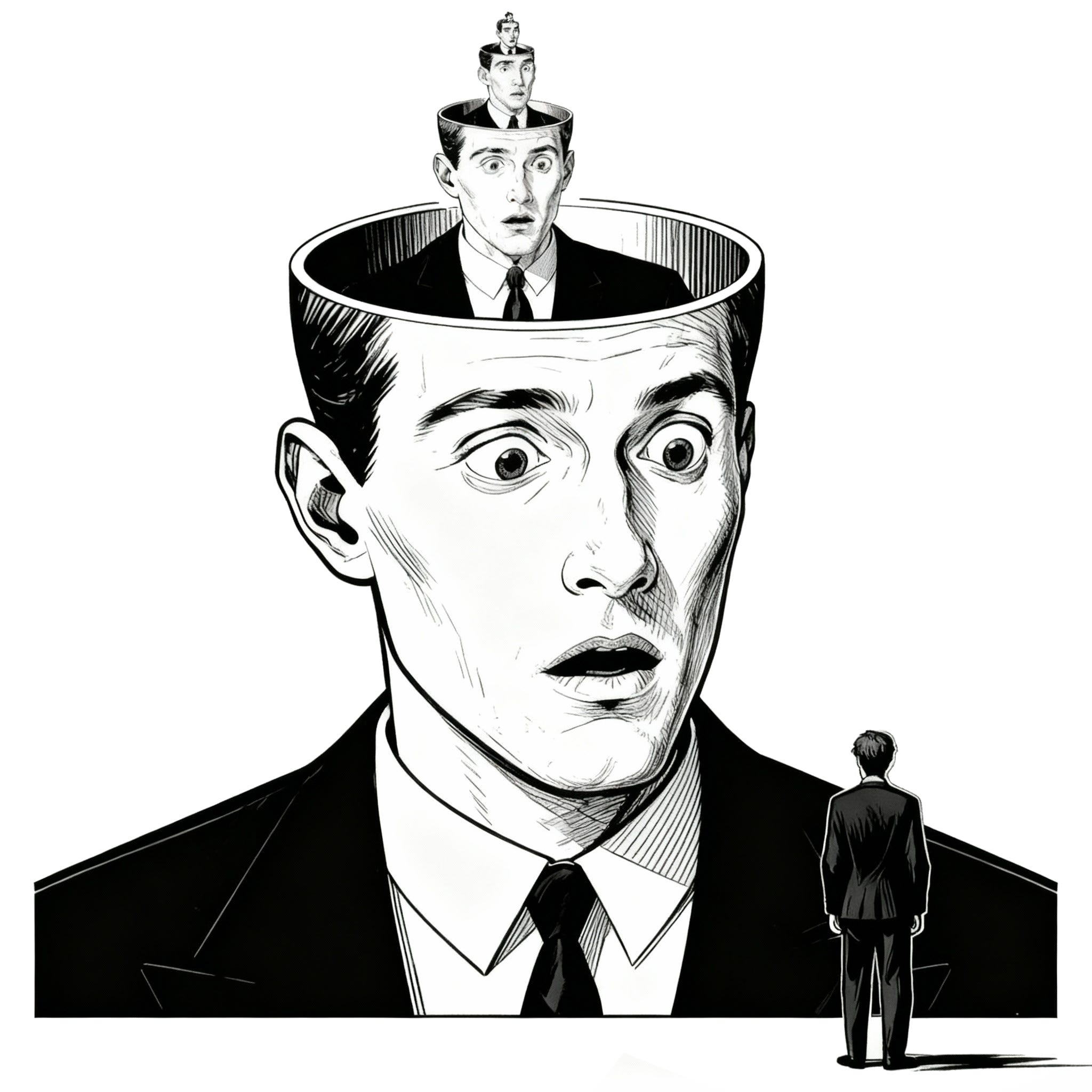
A couple of weeks back I argued that there is no reason to suppose that AIs will ever produce a true “I” — a consciousness, or a perceiver, like you or I know ourselves to be. Then I argued that, similarly, there’s no reason to suppose that any configuration of matter and energy at all could produce consciousness, because there is just nothing objective about subjective awareness, and I think careful observation of the qualities of consciousness alone — as in the contemplative practice of vipassana — reveals it.
This week I thought it would be interesting to explore the underlying idea of emergence, itself: Is it possible for anything to come into being in such a way that it transcends its precursor elements?
The materialist worldview is essentially reductive,1 supposing that everything reduces to things we can describe in terms of physics — matter, energy, forces, etc. The idea is that looking backward, down ontological the tree of evolution, the universe reduces to simpler and simpler elements, ultimately to physical “ontological primitives,” and looking in the other direction, up the ontological tree, this means that the universe has to have a profound tendency to produce emergent behavior.
This tendency is nicely summarized by the Gregg Henriques’s “Tree of Knowledge System,” a cornerstone of his popular Unified Theory of Knowledge (UTOK). Matter, governed by the dynamics of physics, produces the emergent dynamism of life. Life produces the emergent dynamism of mind. Mind produces the emergent dynamism of culture — including (philosophy and) science — as illustrated below:
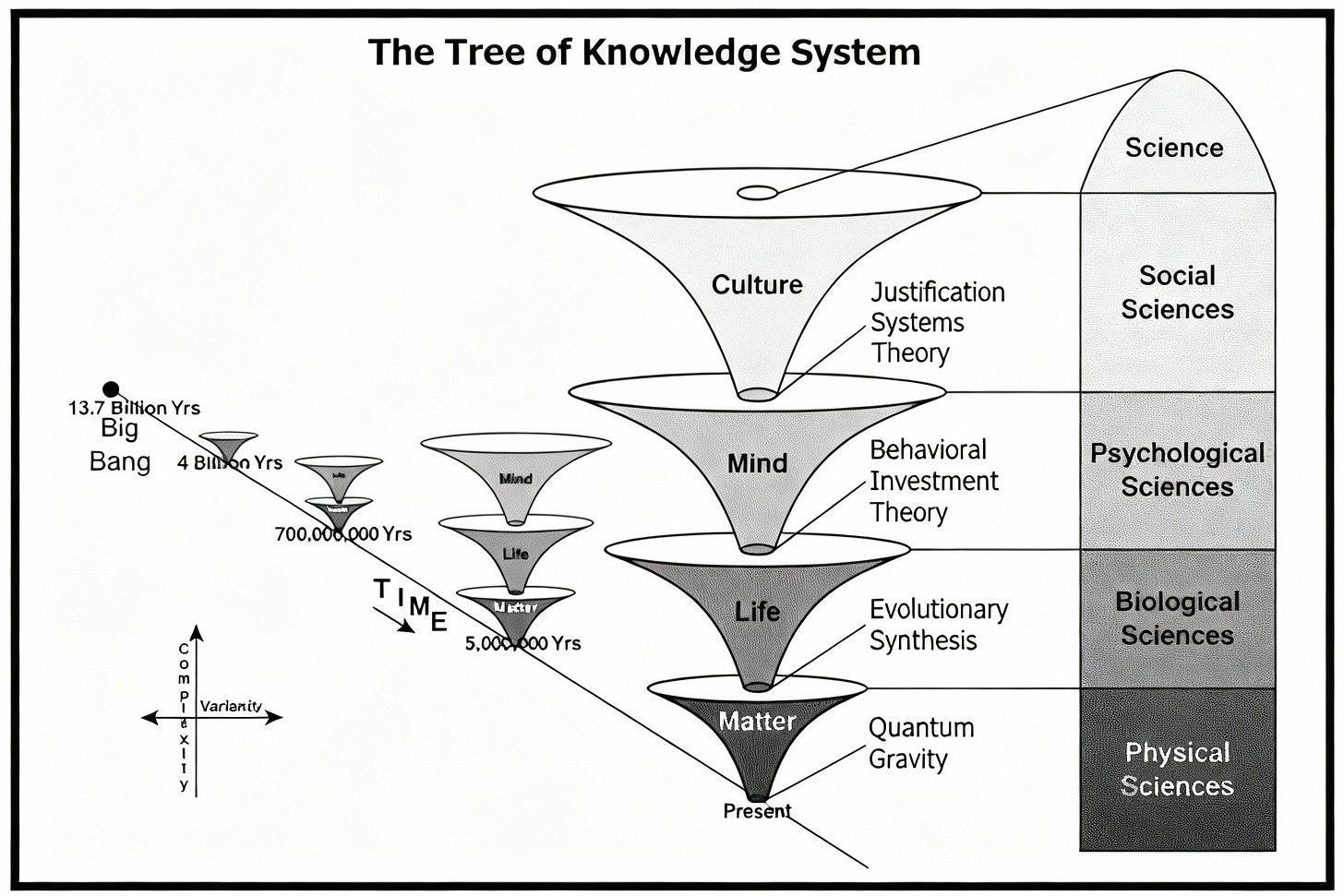
It’s generally held that two possible forms of emergence can exist: weak and strong. Weak emergence occurs when new phenomena arise within the existing laws of a system — e.g., if consciousness emerges within the fixed laws of physics. Strong emergence occurs when the entire definition of the system itself evolves — i.e., if the laws of reality themselves come to be defined differently as existence progresses.
Henriques’s UTOK is a model for strong emergence. Each level of cosmic development creates new emergent dynamics that do not pertain to the previous layers.
This jibes with the model Bobby Azarian describes in his fascinating 2022 book The Romance of Reality. It turns out that as energy dissipates along a gradient from higher concentrations to lower ones, it does exhibit some spontaneous tendency to complexify. (The classic example is the surprisingly ordered spiral effect of water creates as it seeks the optimal path down the drain.) Habits of spontaneous complexification appear to be inherent to the universe at many levels, and they can exert a surprising amount of explanatory power: The universe really does seem to be able to spontaneously generate new types of order.
Some folks find a concordance here with the “process” theology of Alfred North Whitehead, et al., as well — the idea that God’s essence is creativity itself and, perhaps most provocatively, that God evolves.
And all of this jibes with the prevailing spirit of naturalism of our era. There seems to have been some sort of Big Bang, and there don’t seem to have been any people around then, or, say, megafauna or microbes — so the universe does seem to be evolving. And the research that demonstrates some universal tendency toward complexification is truly fascinating. And there’s certainly room in there, even, for a veneer of divinity to the observable universe. Maybe the universe the body of God? As it evolves, God evolves?
Here’s my question, though: Is this kind of emergence — spontaneous creation, an absolute evolution of reality, weak or strong — really possible? Does it really make sense?
To be clear, this is not to disparage UTOK, or process theology, or the wonderful Romance of Reality, or any similar line of thinking. It’s more to question whether strong-emergent models (or even weak-emergent models) are really apt to describe the entirety of everything that exists, or whether they are apt — indeed, perhaps even very apt — to describe the interior of the material-world glovebox, but perhaps not as apt to describe either the glovebox itself, or anything that may lie outside of it.
It seems to me that, in order for true emergence — true novelty — to occur, it has to occur within a closed system — at least, a system sufficiently closed as to rule out the possibility that the emergent phenomenon wasn’t derived from outside elements coming in. In the old European folk tale about the stone soup, for instance, you could say that a delicious soup emerged spontaneously from a stone, if you were looking exclusively at the pot and nothing else. But that would be to treat the pot as a closed system, when it isn’t. It’s an open system receiving incoming material (i.e., the other ingredients of the soup).
To me, the difficulty lies in trying to apprehend the difference between open-system emergence and any idea of ultimate emergence which, by definition, has to occur in a closed system. Because in my experience, arguments in favor of emergence often take local, open-system examples as analogues for an ultimate closed-system phenomenon, when the issue seems to me to be much trickier than that.
For example, the emotional effect of a symphony could be said to be an emergent phenomenon of the physical vibrations of musical instruments. But this effect is not purely a function of the instruments. It’s the result of the interplay between the instruments, the composer, the musicians, the conductor, the audience, and so on. Where does the emergence occur? You’ve not demonstrated that phenomena can be emergent; you’re directed back to the problem of consciousness, itself.
Or, you could take the remarkable argument of The Romance of Reality that complexification is inherent, and emergent. There seems to be little doubt that spontaneous organization is evident in some systems that dissipate energy — like the spirals of water down the drain, and like cyclones. And there’s no doubt that the implications are fascinating. But it seems to me that we can’t be sure of having closed the box, because we don’t necessarily have all the ontological elements in view. Why is spontaneous order exhibited when energy is dissipated, sometimes? What about the ground of reality makes this necessary? What defines the the contours of this phenomenon? The phenomenon is fascinating, but it’s not clear that what’s being described is really at ground, yet.
Because true emergence must occur within a total, closed system, question of true emergence is a question about absolute reality. And I think it’s worth stressing that thinking at the level of the absolute operates in a wholly different way from thinking about local phenomena, and I think this requires frequent recalibration to prevent us from using the logic of finite phenomena to try to account for infinite ones.
To me, this really comes into view when you explore the core premise of process theology — that God evolves.
Suppose that the ground of reality can be called God, and that God is indeed creativity itself, eternally emerging. It’s a wonderful, baffling premise. But is it plausible?
I think it’s worth noticing that, according to its own terms, this simply cannot be a full ontology. Because it does not account for the universe in terms of one thing, it accounts for the universe in terms of at least two things: God and time. Without a dimension to distinguish one state of God from the other, there is no evolution. If God evolves, God must exist, and time must exist, too — apart from God. This metaphysics with two aspects now begs the question about what comprises them (and what provides the impetus for God to move from one to state to the other).
Really, I think four things must exist for process theology to work: God; time; an impetus, and a medium in which God’s evolution is expressed, over time. What is that medium of expression made out of? Where did it come from? What is time made out of, and where did it come from? Etc. Ultimately, a metaphysics in which God evolves actually describes a universe in which God is reduced to a character in a scenario orchestrated by something else as yet unidentified — which is to say, in which God isn’t God anymore. You’re challenged to go at least one level deeper to describe what the ground of things really is.
David Bentley Hart (harkening to others before him) follows this argument to logical the conclusion that, whatever God is, God must be both unchanging and perfectly simple — an original Nature that is essentially consistent and undifferentiated. Because as soon as it’s differentiated in any way — including temporally — you have to account for what’s causing and what’s comprising that differentiation — which involves other things.
Spinoza gets at this early on in his Ethics when he argues, through a strict set of geometry-like proofs, that there can be only one “substance” at the ground of reality (“substance,” as he puts it, is meant to be considered in the most abstract possible way) — and that that “substance” must be infinite, and must contain every attribute.
It must be infinite, he reasons, because if any original, uncreated substance were truly constrained there would necessarily be some other uncreated “substance” to constrain it. But if there were two truly independent substances, they would have no context for interacting, and so they could not affect each other. Therefore, he concludes, there must be one substance at ground.
If this seems a little arbitrary, you can look at the question about the water going down the drain. If this spontaneous organization does occur, it also strongly suggests some phenomena that is causing the constraint — not one substance, but two, at least. And how could they interact if they were not somehow connected, somehow part of a whole?
The original substance must contain all attributes, Spinoza argues, for more or less the same reason. If it were limited in any way, there is a need for a limiting agent — i.e., something wholly independent which, by dint of its total independence, could not interact with anything else, having nothing in common with it.
Spinoza’s framing is a little different, but ultimately, I think the reasoning is akin to the reasoning above about process theology. In the end, totality implies a lack of limit in time, space, or any other aspect of expression or attribute, as well.
You can start to see the peculiar dynamics of talking about totality, and the ways it logically starts to constrain itself in ways that any finite thing doesn’t.
Ultimately, if you can begin to entertain that:
emergence itself cannot be the ground of reality, because emergence is not one thing but several — creating a need to account for what comprises them;
the ultimate ground of reality cannot be limited because, again, then it’s not one thing, but several — creating, again, a need to account for what comprises the several things; and
the whole idea of creation ex nihilo is a little hard to get one’s head around inherently — how does something truly come from nothing?
. . . then I think you’re strongly led toward the idea that the ground of reality begins, as Spinoza argues, as one original substance of infinite attribute — even infinite attribute is contained some unchanging, undifferentiated state.
All of this is definitely a little hard to get one’s head around, and at first look all ontological ideas may seem equally baffling — with nothing to really weigh one against another. But I’m left with the idea that some form of theistic argument is really the more plausible one.
Which argument seems more viable: the idea that existence is a series of tiers up from an essential nothingness, in which, repeatedly, new phenomena self-create, with no apparent cause — or that existence is, at ground, a state of all potentialities — including all potentialities of being and consciousness, from which particular phenomena precipitate, through a process of self-restriction of the Source?
To me, the question reminds me of the difference between dividing zero by any number and dividing any number by zero:
If you have eight grapes and four cups, and you put the same number of grapes in each cup, how many grapes go in each cup? The answer is easy: two grapes.
If you have zero grapes, and four cups, and you put the same number of grapes in each cup, how many grapes go in each cup? You might wonder why you’d bother to ask this question, but the answer is also easy: zero grapes.
But what if you have eight grapes, and you have zero cups? How many grapes go in each cup?
This last question is uncanny. It defies the nature of operations. It gives well the intuition that division by zero is undefined. To me, the something-from-nothing idea has a similar uncanny, “undefined” quality that the something-from-everything idea lacks.
Well, we’re dealing with the infinite, you might say. Maybe that is going to feel a little uncanny to us.
Okay. But how uncanny should we expect it to be?
This is actually something I think is really worth discussing, and I’d like to discuss it in a later essay.
But before we get there, it seems to me that it’s worth deconstructing the core assumptions that inflect the conversation overall — which I hope to address next week.
In the meantime, there is to consider that we live in a reality in which phenomena precipitate, but they do not emerge. Beings may evolve. Formations may evolve. The totality doesn’t. Because it can’t.
This series of essays continues here.
As, when I think about it, most ontologies are.